Rail & Marine
Passive safety development applied to trains
Full Scale Rail Body Crashworthiness
Simpact roots are in automotive safety, but when we are asked to develop the crashworthiness of a train, the same fundamentals of passive and active safety can be applied.
Safety & Durability
Both Directors of Simpact wrote their PhD theses on automotive safety topics. Tims thesis title reads “The frontal impact response of a spaceframe chassis sportscar”. While Tims work focused on the structural response of a Caterham to frontal impact loads, Dirks thesis titled “Rapid Design of Crash Properties for Safe Automobiles: A Conceptual Approach” focused more on the interaction between occupants and the vehicle during a crash.
Creating safer cars has a direct positive effect on the wellbeing of future crash victims and their loved ones. This knowledge really motivates us. It of course also applies to any other form of transportation.
Incidents with trains often attract international attention. Perhaps this is because of the number of passengers involved. The first line of defence is crash avoidance through robust design and maintenance of rolling stock and infrastructure, you could class this as “active safety”. The service life is typically decades.
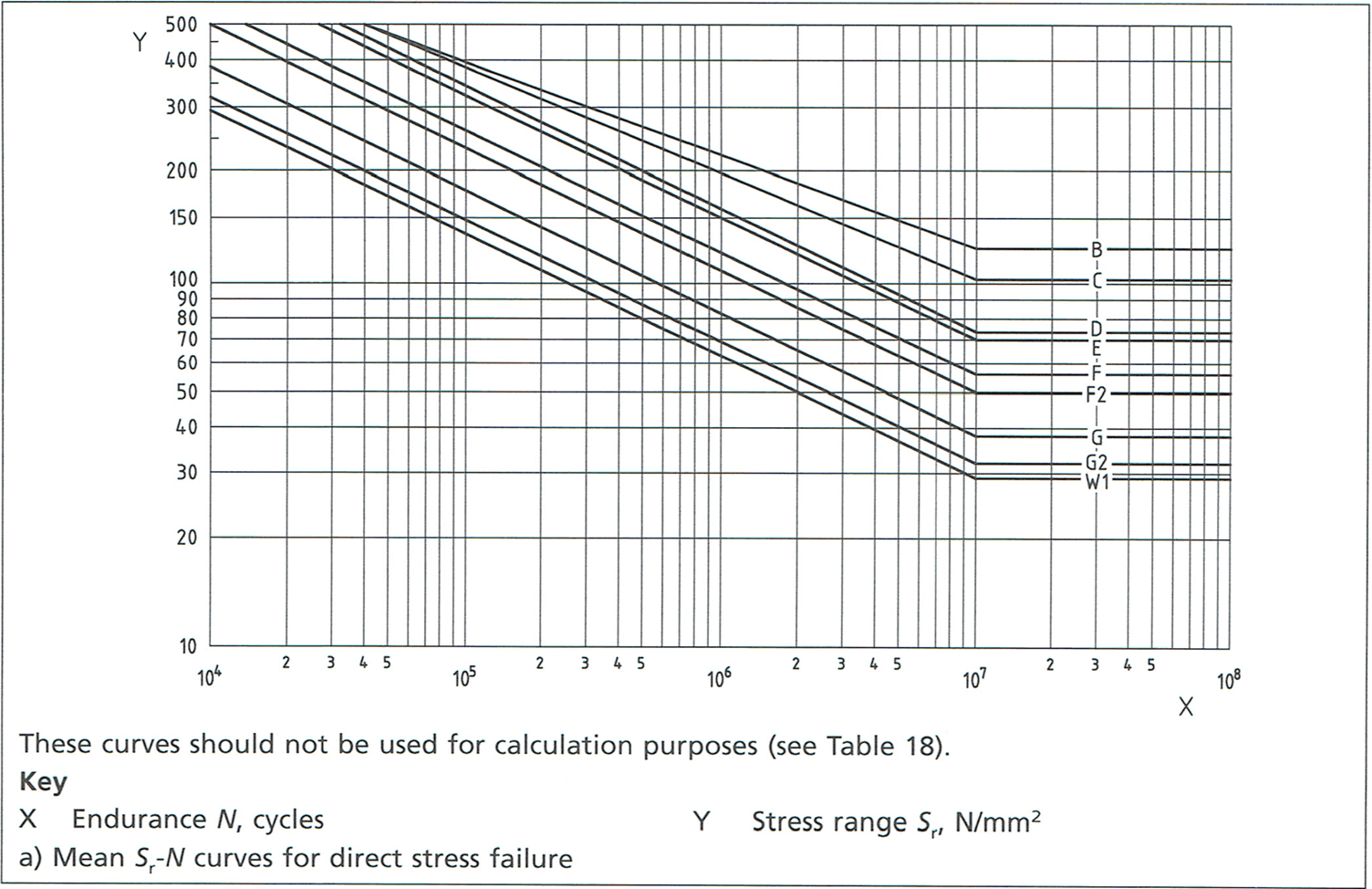
A large proportion of Simpact’s work for the rail industry involves fatigue life calculations and design guidance to achieve the required durability. For metal structures, typically principle stress ranges can be compared to S-N curves. Standards such as BS 7608:2014 describe the process.
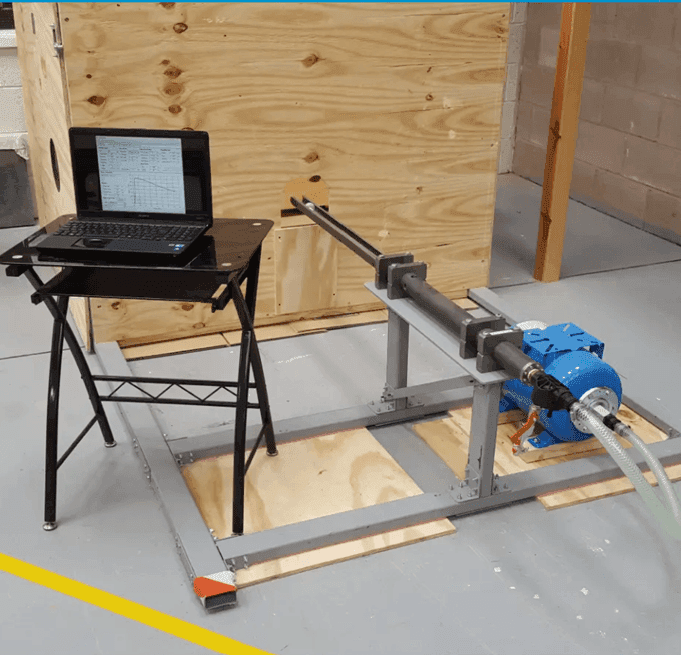
Occasionally we are asked to about passive safety in train design. Typically this ranges from mitigating passenger impacts with interior components in case of a crash and shielding occupant from ballast etc. Our in-house pneumatic launcher is used to test bodyside train windows to the small missile test carried out in rail standard GMRT2100.
However, on this occasion we were approached by VIVARAIL to upgrade the crashworthiness of their D-train platform. D78 Stock originally operated on the London Underground (LUL) network and VIVARAIL purchased several for re-purposing. As for all aspects of their train, they wanted to out-perform expectations and so it was important to them to prove a) the original train was in perfect structural condition and b) that work to strengthen and increase the cab’s structural integrity would provide the additional protection they intended.
This provided a perfect opportunity for us to apply our knowledge and experience that helped shape the modern automotive crashworthiness development process to the rail industry. This involved virtual testing making use of detailed computer models.
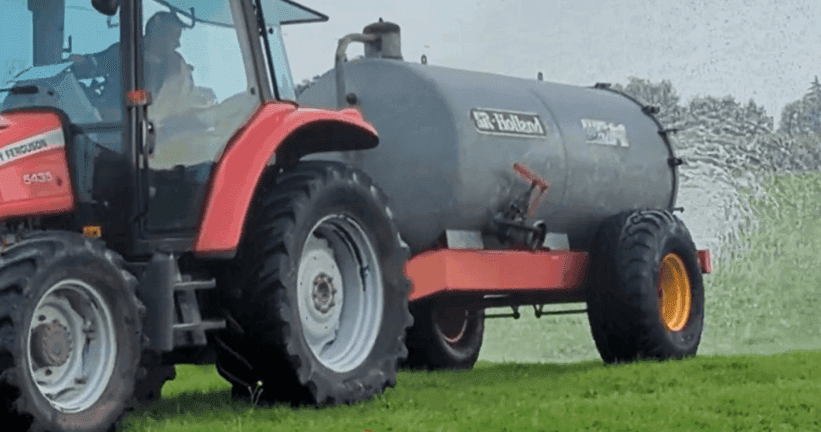
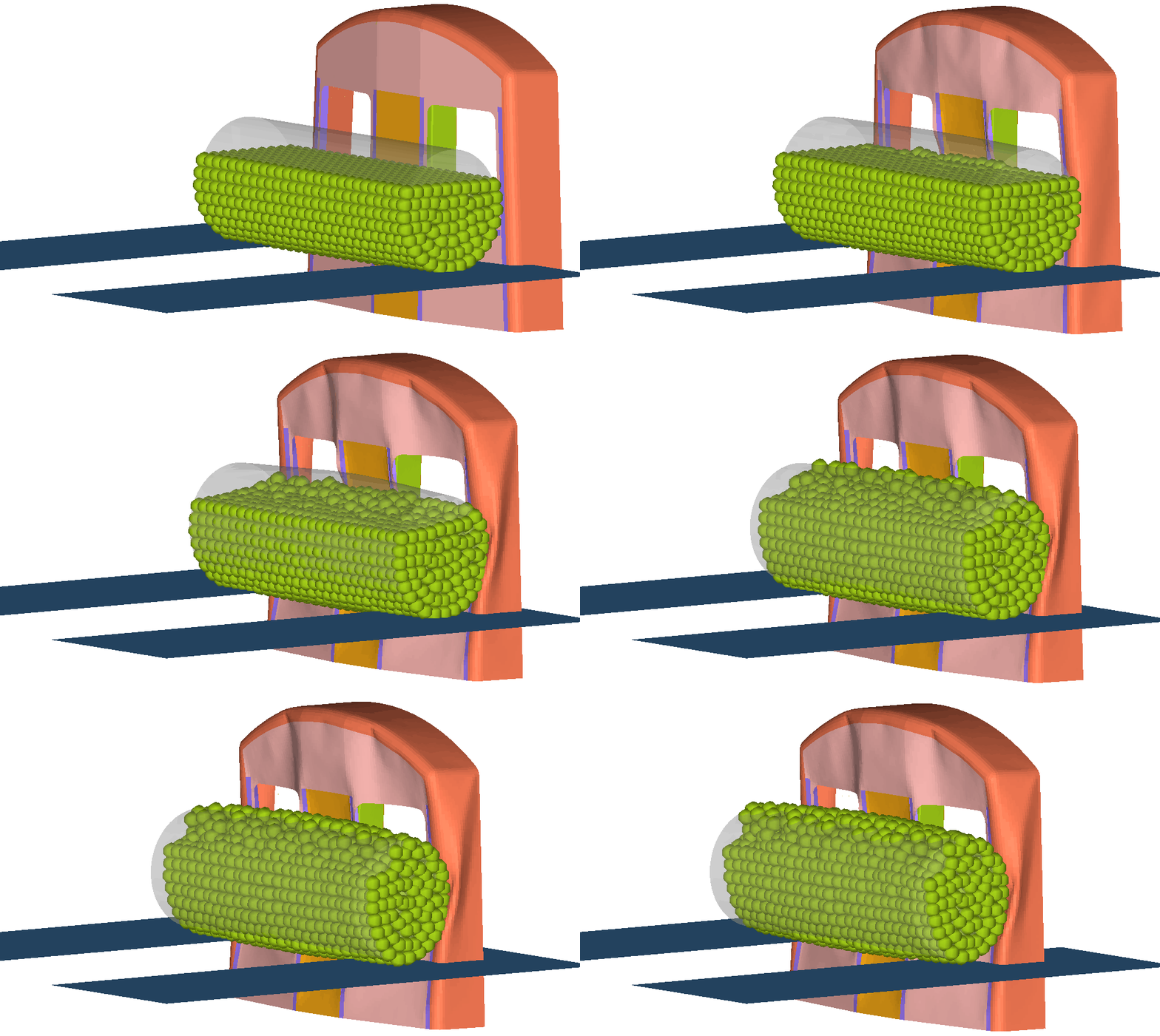
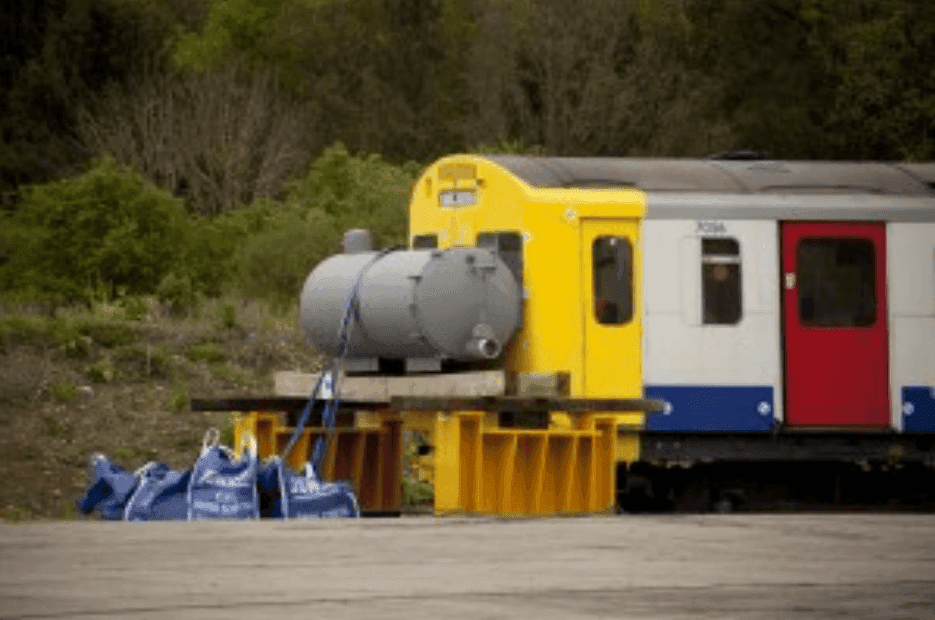
As the repurposed stock would run on rural lines with crossings for farm vehicles, an encounter with a slurry tanker was picked as a relevant crash load case.
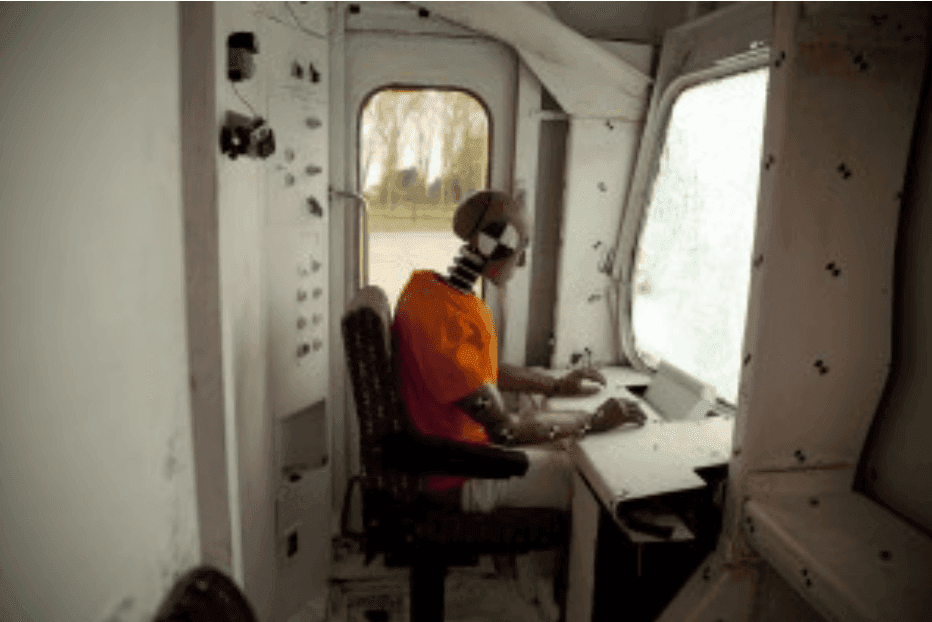
Unlike in typical automotive crash scenarios, the mass of any mobile obstacle is typically an order of magnitude lower or less than the train. This means that deceleration levels in the train are much lower than in car-to-car crashes. The main focus therefore becomes the survival space for the train driver and passengers. With our experience in the design of crumple zones in tight packaged vehicle front ends Simpact was the perfect partner for developing a reinforcement pack to be retrofitted to the D stock trains.
FEA Method including Smooth Particle Hydrodynamics (SPH)
To tune and validate the design we followed the same approach as what is nowadays common practice at large automotive OEM’s. We minimised the need for expensive and time consuming physical testing by relying on computer simulations.
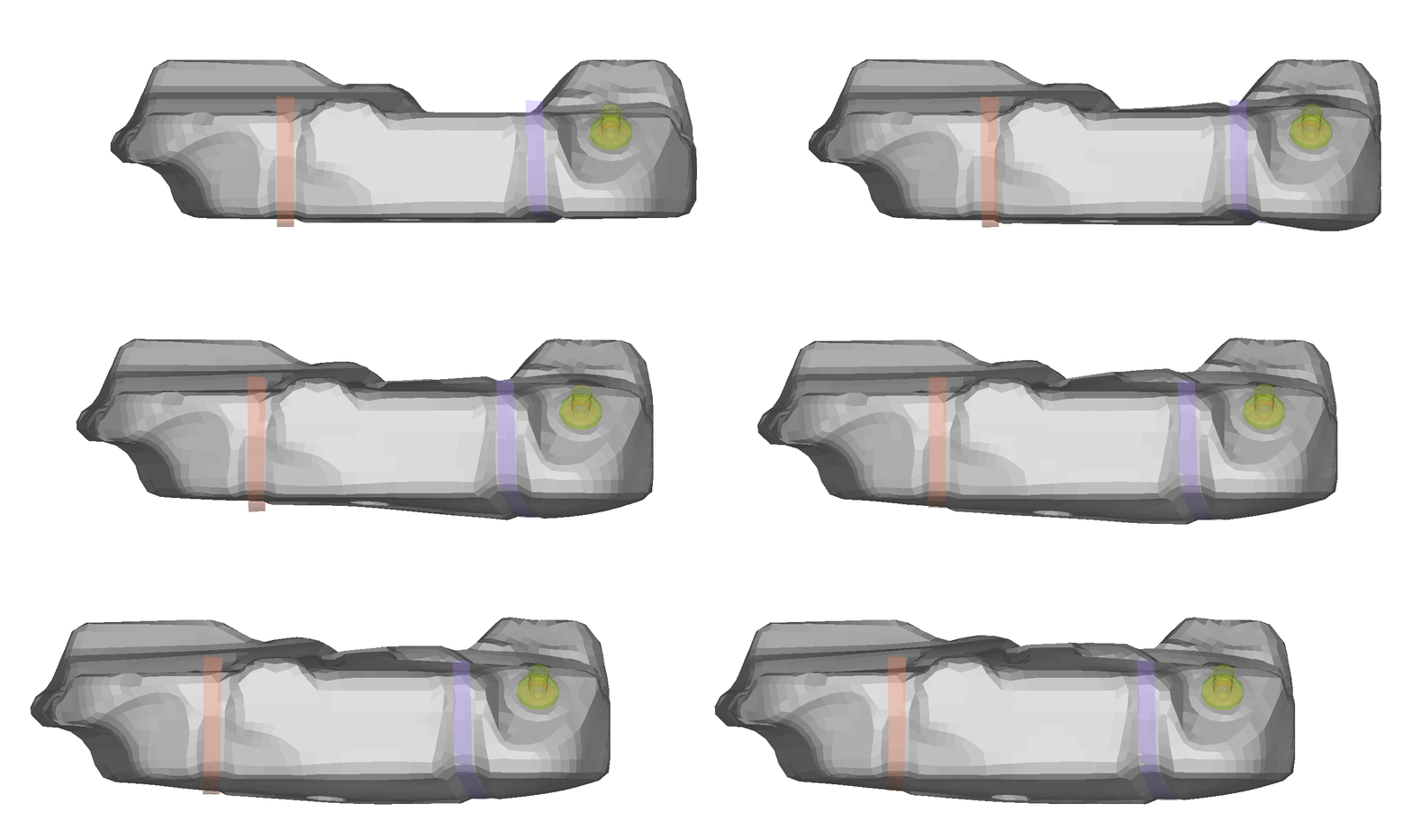
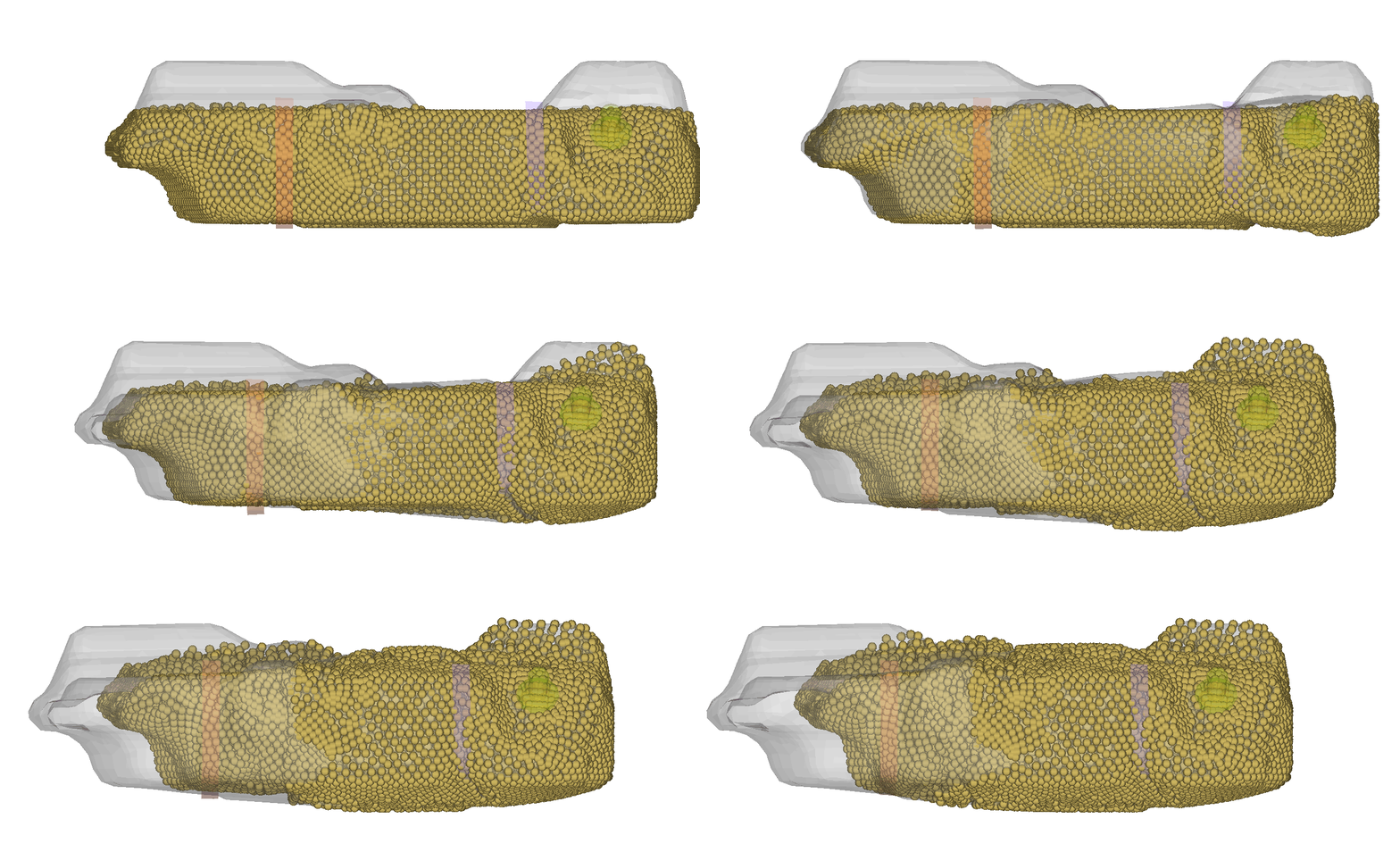
Then there was the challenge of building a representative model of the heavily loaded slurry tank. There are parallels with how fuel tanks in cars behave in a crash scenario. The inertia of the liquid induces a load on the walls of the tank when accelerated by the surrounding structure. To simulate this behaviour, the Smooth Particle Hydrodynamics (SPH) method is used. In the model you represent the liquid as imaginary spheres that can move relative to each other and their interaction is defined by functions that mimic the physical properties of the liquid.
We employed the same SPH technique for the slurry tank. We digitised the tank to build a CAD model. From this CAD model we generate a finite element model which we filled with SPH cells to the correct level.
Full Scale Crash Test
VIVARAIL developed a CAD model of the train structure that we could use to generate a finite element model. We carried out coupon tests to characterise the mechanical properties of the materials used in the crash structure. A crucial step, as typically material standards only dictate minimum yield and tensile strengths and elongation at break. When you want to calculate the crush behaviour of a structure, you need to know the actual properties of the material used, not just the guaranteed minimum values. With computer models of both the train and crash scenarios including the bespoke obstacle in place, the development of the crash structure could be done in the virtual world.
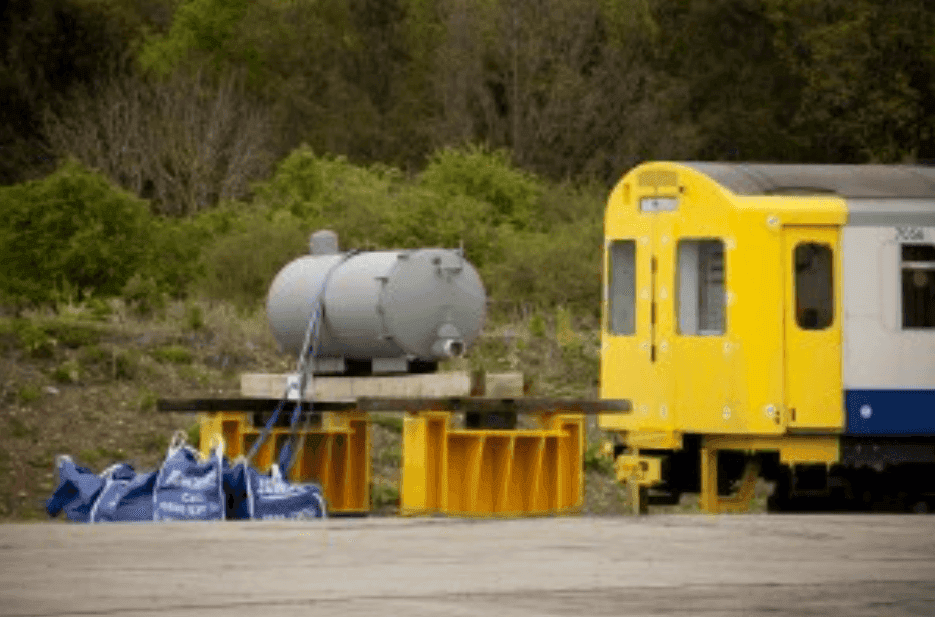
To validate the calculations and demonstrate the performance to the interested parties we designed and modelled a full scale crash to be carried out at the Quinton Rail Technology Centre, Long Marston. This meant that there would be no surprises.
On Friday the 8th May 2015, the confirmation test took place. It demonstrated the safety of the train for the chosen crash scenario and confirmed the validity of the computer models.